







Benefits of Outsourcing Accounting and Bookkeeping: What You Gain in Money, Time, and Deadlines
Outsourcing accounting and bookkeeping is easy to recommend in general and harder to judge for your own business. The benefits show up in three places: the cost compared with hiring, the owner hours you get back, and the deadlines you stop missing. This article puts each one into real numbers, then covers the trade-offs that sales pages tend to skip.
The short answer is that outsourcing makes the most sense when your bookkeeping is steady and time-consuming, when no one in-house owns it well, and when your hours are worth more somewhere else. It makes less sense when your volume is very small, or when you need a full-time specialist who knows your operations inside out.
Start with the full cost of an employee
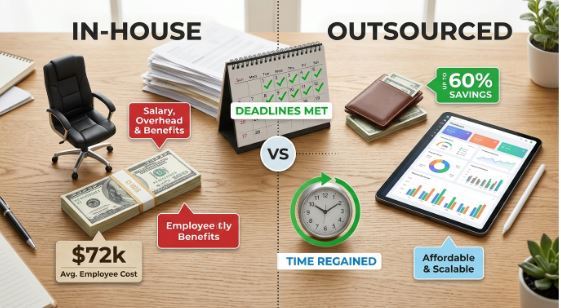
The most common comparison is a bookkeeper’s salary against a monthly fee from an outside firm. That comparison leaves out a lot. The Bureau of Labor Statistics reported a median annual wage of $50,670 for bookkeeping, accounting, and auditing clerks in May 2025. The BLS’s June 2026 compensation data shows that benefits make up about 30 percent of total compensation for private industry workers. That means each dollar of wages comes with roughly 43 cents more in benefits and employer taxes. On the median wage, the employer’s cost lands at about $72,000 a year before you add software, training, and the time it takes to supervise the person.
That figure is a benchmark, not a quote. Your local pay, your experience requirements, and your benefit plan will change it. It still shows why a full-time hire only makes sense when there is enough work to keep one person busy.
Outside pricing is harder to pin down, because providers publish their own price guides and the ranges disagree. Basic bookkeeping often runs from a few hundred dollars a month to about $1,500, and full-service work with controller review costs more. Treat those numbers as rough. Even so, $300 to $1,500 a month works out to roughly $3,600 to $18,000 a year, which is a different budget conversation than a $72,000 hire. Keep in mind that an outside firm is usually buying a defined scope of work. The useful question is how many hours your books need each month.
The hours you get back
One of the clearest benefits of outsourcing bookkeeping is time, mostly because bookkeeping arrives in small pieces. A receipt here, a bank feed there, a bill that needs coding. Accounting firms commonly estimate that owners who keep their own books by hand spend five to ten hours a week on them. Over 50 working weeks, that is 250 to 500 hours a year.
Owners tend to feel that time more than they count it. A TD Bank survey of 508 small business owners found that almost half named bookkeeping as their least favorite task, and 58 percent of owners working 60 or more hours a week said it was especially draining. A QuickBooks survey from December 2025 found that more than two-thirds of U.S. small business owners take a do-it-yourself approach to their books, and only 21 percent work with a dedicated accountant or bookkeeper year-round.
Put a number on it and the picture gets clearer. If your time is worth $75 an hour, 250 hours a year is about $18,750 of work that isn’t moving your business forward. That alone doesn’t mean you should outsource everything. It does mean you should check whether those hours are the best use of you.
Deadlines you stop worrying about
Some of the most practical benefits of outsourced accounting are about timing. Federal estimated tax payments for 2026 are due April 15, June 15, and September 15, with the last one due January 15, 2027. Each payment depends on the income you earned in its period. If the books are behind, you are guessing. A guess that runs low can bring underpayment penalties, and a guess that runs high ties up cash you could use.
A team that closes your books every month gives you current numbers when those dates arrive. It also catches problems earlier. A miscoded payment found in March is usually a quick fix. The same mistake found in December can mean a weekend of digging through bank statements from the spring.
Monthly reporting has a second benefit. When profit and loss figures are accurate and arrive on schedule, pricing and cost problems show up sooner. Lenders and buyers also expect consistent statements, and those are much easier to produce when someone maintains them every month. Our bookkeeping services are built around that monthly rhythm.
Access to a team, not one person
An in-house bookkeeper is a single point of failure. If that person takes a month of leave, gets sick during tax season, or leaves for another job, the work either stops or lands on you. A good outside firm usually has several people who know your file, a backup for each role, and a reviewer who checks the work before it reaches you. Ask how coverage works, because it is one of the most practical benefits you will get.
There is also the benefit of repetition. A provider that works with many small businesses sees the same QuickBooks setup questions and filing problems again and again. That experience often turns into faster answers, and it means you don’t have to be the one who knows every rule.
Trade-offs to weigh honestly
Outsourcing has real downsides. You give up some day-to-day control, and quality depends on the provider. A low-cost plan may only categorize transactions and nothing more. Ask who reviews the work, and whether reconciliations happen every month or only at year-end.
Data security is the other big question. Your bank feeds and tax records are sensitive. Firms that prepare tax returns fall under the FTC Safeguards Rule, which requires a written information security program and oversight of service providers through contracts. IRS Publication 4557 covers similar ground for tax professionals. Not every bookkeeping vendor is a tax preparer, so the rule may not apply to a given provider. Ask anyway. Find out who has access, whether multifactor authentication is required, how data is encrypted, and what happens to your records when the relationship ends.
Outsourcing also can’t fix missing information. A bookkeeper can’t categorize a receipt nobody uploaded or record a loan nobody mentioned. You still need a routine for sending bank access, receipts, and questions. Quick, complete responses lower both your costs and your error rate.
Who benefits most
Among the benefits of outsourcing bookkeeping for small businesses, the largest tend to show up when transaction volume is steady, several bank and credit card accounts are in use, payroll or sales tax duties add to the workload, and the owner is already spending real time on the books. Contractors, professional service firms, and retailers with regular purchasing often fit that pattern. A business with only a handful of transactions a month may get more value from an annual review with a CPA than from a monthly plan. Our industries page shows the sectors we work with most.
The benefits of outsourcing accounting services also depend on what you ask for. A bookkeeping-only plan covers the records. Adding controller review, cash flow reporting, or advisory work costs more, but it changes what you get from your numbers. Decide which of those you need before you request quotes, so you compare like with like.
What to ask before you sign
A few questions separate a useful provider from an expensive one. Ask who will do the daily work and who reviews it. Ask how often bank accounts are reconciled and which reports you will receive, and when. Ask what the monthly fee includes and what gets billed separately, such as cleaning up past years or building custom reports. Ask how your data is protected and whether the contract says so. Finally, ask how the relationship ends and how quickly you can get a full copy of your records.
How BAS Business approaches the work
BAS Business provides bookkeeping, payroll, accounts payable and receivable, banking support, and fractional controller services for small businesses in Oregon and across the country. We also offer QuickBooks consulting for setup and training, so your team understands the books it relies on. If you want to see how this would apply to your business, the first step is a no-charge conversation. If we can’t give you a price right away, we review your records or QuickBooks file and send a proposal to sign. You can book a free consultation any time.
The benefits of outsourcing accounting and bookkeeping are real, but they depend on your situation. For a steady business with a lot of transactions and an owner who is stretched thin, outsourcing can lower the cost of the work, protect your deadlines, and put current numbers in front of you every month. For a very small business, or one with needs that call for a full-time specialist, the answer may be different. Start by counting your hours and mapping your deadlines, then compare each option against what you would actually be buying.