







Double Entry Accounting Explained: What It Means and How It Works
If you have ever looked at an accounting software screen or an accountant’s report, you have probably seen the words double entry. Most owners nod and move on. The idea is actually simple. Every money move gets written down twice, in two places. This guide explains it in plain English, with an example you can follow.
What Is the Double Entry System of Bookkeeping?
The double entry system is a way of keeping business records. Every transaction is recorded in at least two accounts. One side is a debit, and the other side is a credit. The total of the debits must always equal the total of the credits.
So what is a double entry system in practice? Think of every money move as a handshake. One side gives and the other side receives. The system writes down both sides, so nothing gets lost in between.
What Does Double Entry Accounting Mean?
You will see several names for the same method. Double entry bookkeeping, double entry accounting, and the double entry system usually mean the same thing. When people say double entry accounting, they often mean the whole process. That runs from recording each transaction to building the reports at the end.
Bookkeeping is the daily recording. Accounting is what you do with those records once they are in order. Double entry is the rule that ties the two together, so both sides always match.
How Double Entry Works Behind the Scenes
Everything in the system rests on one formula. Assets equal liabilities plus equity. Assets are what the business owns, such as cash and equipment. Liabilities are what it owes, like a loan or an unpaid bill. Equity is the owner’s share. Every entry you record has to keep this formula in balance.
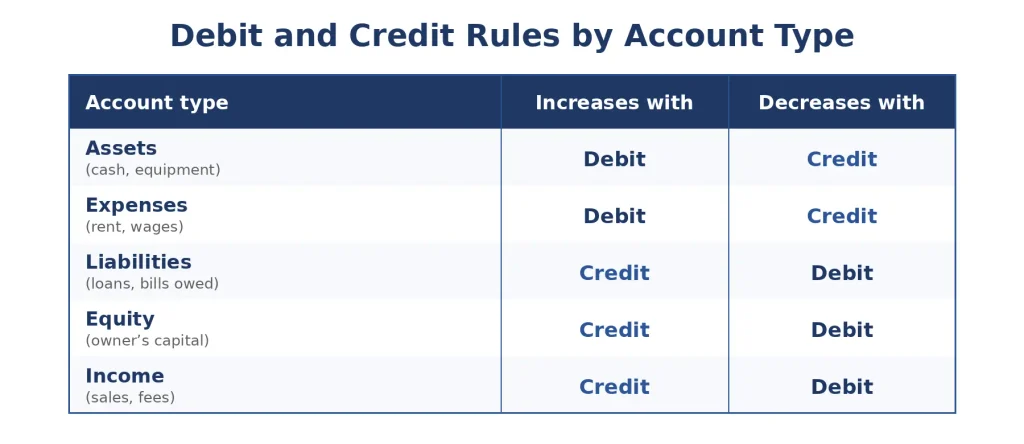
Debits and credits are not good or bad. They are just the left side and the right side of an entry. Each account type grows on one side and shrinks on the other. Assets and expenses increase with a debit. Liabilities, equity, and income increase with a credit.
A Simple Example
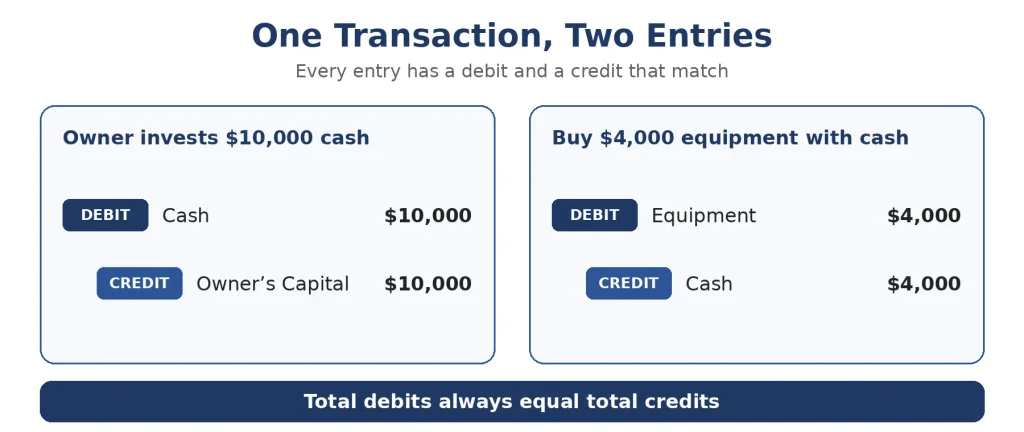
Say you start a small business and put $10,000 of your own money into a business bank account. The cash goes up, so you debit cash for $10,000. Your investment goes up too, so you credit owner’s capital for $10,000.
Later, you buy a $4,000 computer and pay for it from that account. The equipment goes up, so you debit equipment for $4,000. The cash goes down, so you credit cash for $4,000. Both sides match, and nothing is guessed.
One more common case is a sale on credit. Say a client receives $2,000 of work and agrees to pay next month. You debit accounts receivable for $2,000, because the client now owes you. You credit sales revenue for $2,000, because you earned the income. The books balance, even though no cash has moved yet.
Double Entry vs Single Entry
Single entry is the simpler approach. It tracks money in and money out, usually in a notebook, spreadsheet, or cash log. It can work for a very small business with few transactions.
Double entry goes further. Because every transaction has two sides, it can produce a balance sheet and a profit and loss statement. It also has a built in check. If the debits and credits do not match, you know something went wrong before it reaches a tax return.
Where the System Came From
The method is much older than most software. Italian merchants were using a form of it during the Middle Ages. Luca Pacioli, a friar and math teacher, described it in his 1494 book, Summa de Arithmetica. Five centuries later, the core idea has not changed. Only the tools have.
How Double Entry Helps Your Business
The biggest benefit is accuracy. A trial balance lists every account and its total. If the debit column equals the credit column, the books are in balance. If not, you have a mistake to find. It also helps with fraud, since it is harder to hide a payment when every entry needs a second side. Banks and investors trust these reports because they follow a standard structure.
Balanced Books Are Not Always Perfect Books
Here is the honest part. Balanced books do not prove everything is right. You can still post a sale to the wrong account, or enter the same bill twice. The totals still match, but the report is wrong. That is why regular review matters as much as the system itself.
Step by Step: How Entries Move Through the Books
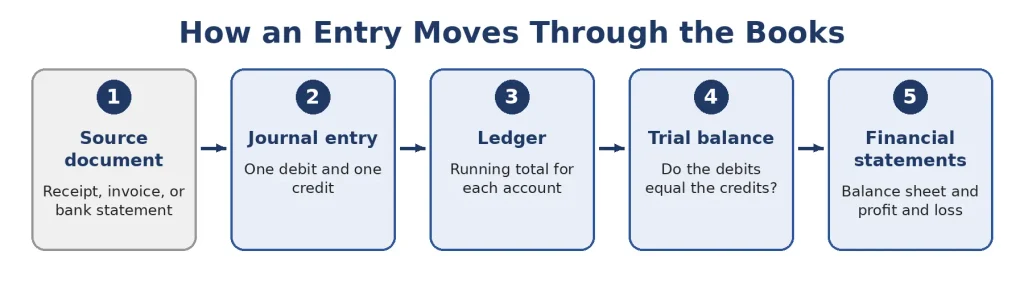
Most double entry work follows the same path. It starts with a source document, like a receipt, an invoice, or a bank statement. That document becomes a journal entry with a debit and a credit. The entries are posted to the ledger, where each account keeps a running total. Those totals feed a trial balance, and the numbers finally become financial statements.
Accounting software handles most of these steps. You still need to understand each one so you can check the output.
Do Small Businesses Need a Double Entry System?
Many small businesses start with single entry and switch once things get more complex. When you have employees, inventory, loans, or a bank that asks for a balance sheet, double entry becomes very useful. Most modern tools, including QuickBooks and FreshBooks, record transactions this way by default. The software does the math. Your job is to code each transaction to the right account, and that is where most small businesses need help.
Signs You Have Outgrown Single Entry
You are probably ready for double entry if you need a loan, you pay employees, you carry stock on the shelf, or your accountant keeps asking for a balance sheet you cannot produce. At that point, the extra structure saves time. It also makes the numbers easier to trust when you make big decisions.
How BAS Business Can Help
Our bookkeeping team works with double entry every day. We record transactions, reconcile bank accounts, review entries, and check the trial balance before reports go out. You can see the full scope of our bookkeeping services.
If your QuickBooks file was set up in a hurry, our QuickBooks consulting team can clean up the account setup and correct past entries. We also support contractors and service firms through our industry work, where job costing and billing make account choices more involved.
You can read more about who we are on our about us page. Ready to talk? Contact our team or call (503) 451-3425. We respond within 24 hours on weekdays.
Double entry is simple in idea but takes care in practice. Learn the rules, check your totals each month, and ask for help when the books stop making sense.
Frequently Asked Questions
It is a method where every money move is recorded in two accounts, once as a debit and once as a credit. The totals always match.
It is the same method used across the whole process, from recording each transaction to preparing financial statements. Double entry bookkeeping and double entry accounting usually refer to the same system.
If you buy a $4,000 computer with cash, you debit equipment for $4,000 and credit cash for $4,000. The equipment goes up and the cash goes down by the same amount.
Every transaction affects two sides of the business. Equal debits and credits keep the accounting equation balanced, so you can spot errors quickly.
It is Assets = Liabilities + Equity. Every debit and credit you record has to keep this equation in balance. If it does not balance, something was entered wrong.
A debit is the left side of an entry and a credit is the right side. The words do not mean good or bad. Whether an account goes up or down depends on its type. Assets and expenses go up with a debit, while liabilities, equity, and income go up with a credit.
Yes. QuickBooks records transactions this way in the background. You enter a sale or a bill, and the software posts the matching debit and credit.
Not always. Very small operations can use single entry, but double entry gives a fuller picture and is needed for a full balance sheet. Ask your accountant which method fits your business.