






Bookkeeping vs Accounting: What’s the Real Difference?
If you run a small business, you have probably heard bookkeeping and accounting used as if they mean the same thing. Your neighbor says she needs an accountant. Your friend says he already has a bookkeeper. Most owners just nod and move on. But these are two different jobs, and knowing the difference can save you money, stress, and a lot of time at tax season.
What’s the Difference Between Bookkeeping and Accounting?
The simplest way to think about it is this. Bookkeeping is about recording what happened. Accounting is about understanding what it means.
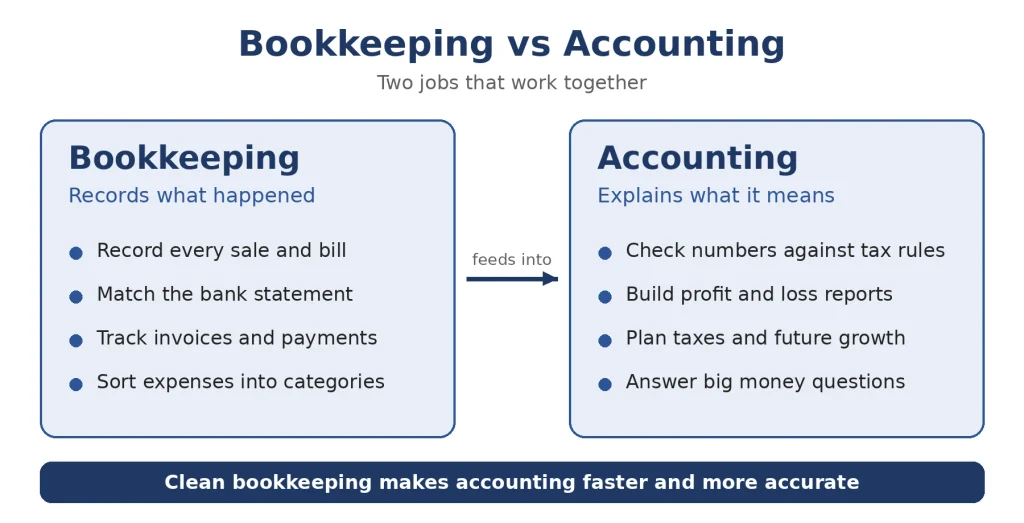
Bookkeeping is the steady, day-to-day work of writing down every money move in your business. Each sale, bill, payment, and bank deposit gets recorded in the right place. It is detail work, and it has to happen on time, or the numbers fall behind.
Accounting takes those records and turns them into a bigger picture. An accountant checks the numbers against tax rules and reporting standards, then uses them to answer bigger questions. Did we make a profit this year? How much tax do we owe? Can we afford to hire someone next spring?
Think of a ball game. The scorekeeper writes down every point, foul, and substitution. That is bookkeeping. The coach reads those notes, spots what is working, and changes the game plan. That is accounting. A coach with bad notes is just guessing.
Accounting also covers tax planning, financial statements for banks and investors, and audits. Some accountants are CPAs, which means they passed a national exam and hold a state license. Bookkeepers usually do not need a degree or a license, though many take courses and earn certifications in software like QuickBooks.
Here is the key point. Bookkeeping feeds accounting. If the books are messy, the accountant spends hours cleaning them up before doing any real work, and you pay for every one of those hours.
What Does Bookkeeping Do for a Small Business?
Bookkeeping does a lot more than keep your files neat. Its real job is to show you where your money stands right now. Many owners only find out they are short on cash when a payment bounces. Good books give you a warning weeks earlier.
It keeps your bank balance honest. It tracks who owes you money and who you owe. It sorts your expenses so tax time does not turn into a scramble. It also catches mistakes, like a duplicate vendor payment or a subscription you forgot to cancel. And it gives you the reports you need when you apply for a loan, look for a grant, or think about selling part of the business.
Problems Good Bookkeeping Solves
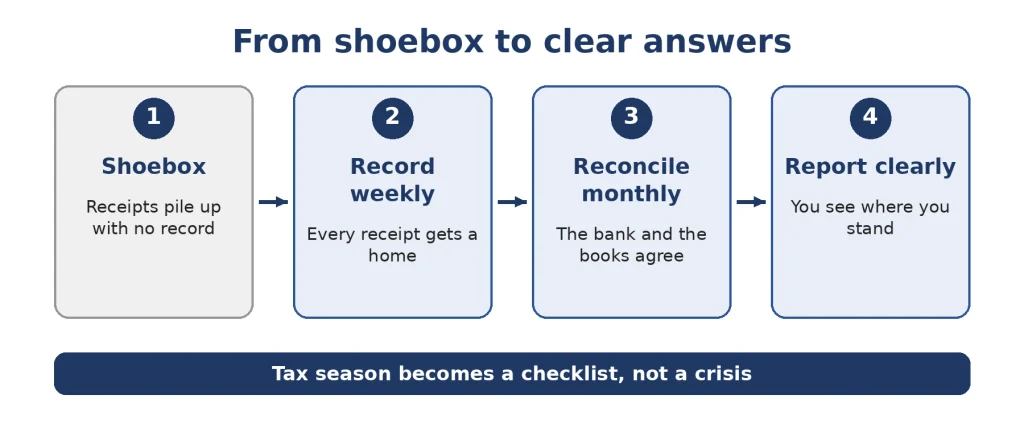
Picture a small plumbing company with five trucks and eight workers. The owner is great with pipes but hates paperwork. Receipts end up in a shoebox in the truck. Three charges on the bank statement have no clear reason. When tax season arrives, the accountant spends two weeks sorting it all out, and the bill is much higher than it needed to be.
This is exactly the kind of problem bookkeeping solves. When transactions are recorded every week, each receipt has a home. When the bank account is reconciled every month, the statement and the books agree. When invoices are tracked, late payments get noticed early, so you can call the customer before the money goes stale.
What Bookkeepers Do Every Day
If you have ever wondered what bookkeepers do, the honest answer is steady, careful work. The details change from one business to another, but most bookkeepers handle the same core jobs.
Daily and Weekly Work
Most of the time goes into transactions. A bookkeeper records sales, purchases, and payments, then places each one in the correct account. Expenses get sorted into categories so you can see where the money goes. Many bookkeepers also send invoices, track who has paid, and follow up on bills that are past due. The goal is simple: keep the records current so nothing piles up.
Monthly Work
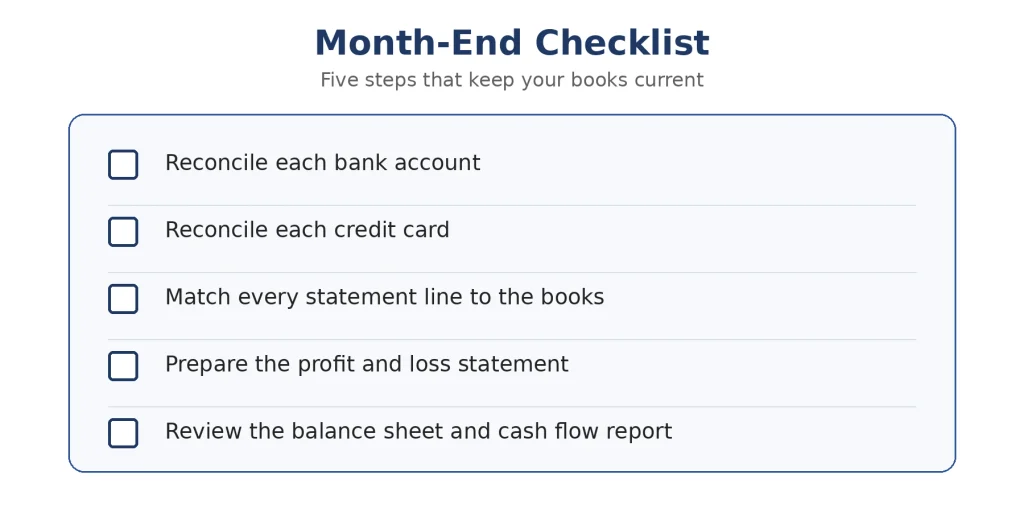
Once a month, the job gets bigger. A bookkeeper reconciles each bank account and credit card, which means matching every line on the statement with what is in the books. If something does not match, they track it down. Then they prepare the usual reports, including a profit and loss statement, a balance sheet, and a cash flow report. These show how the business did and where it stands today.
Year-End Work
Near the end of the year, bookkeepers get everything ready for taxes. They organize records for your accountant, check that forms like 1099s for contractors are in order, review equipment and vehicles for depreciation, and confirm payroll taxes were paid on time. A good bookkeeper turns tax season from a crisis into a checklist.
Our team at BAS Business handles these same tasks for clients in Portland and across the country. To see how the work fits your business, take a look at our bookkeeping services.
Do You Need a Bookkeeper, an Accountant, or Both?
For most small businesses, the answer starts with a bookkeeper. Clean records come first. Once the books are accurate and current, an accountant can do much more with the numbers.
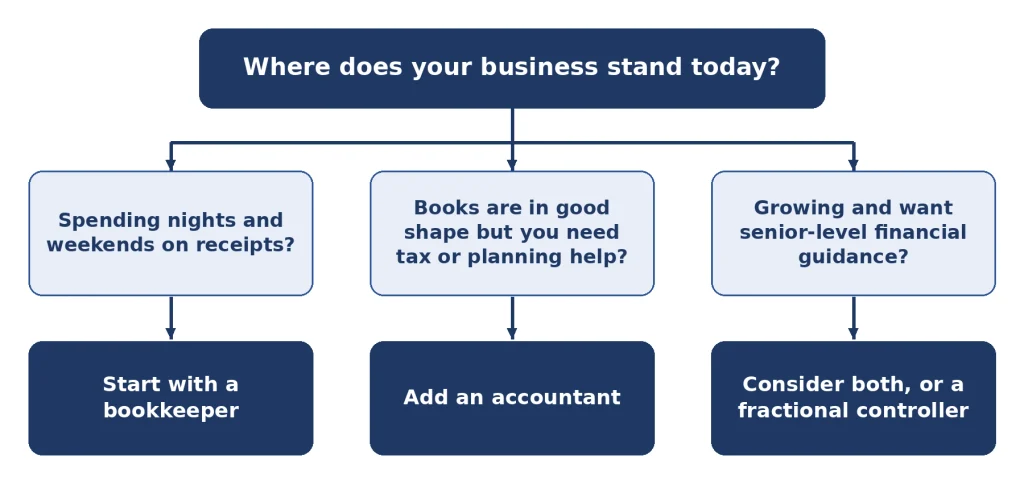
Here is a simple way to decide. If you spend nights and weekends on receipts, or you dread opening your bank feed, you need a bookkeeper. If your books are in good shape but you want help with taxes, planning, or big money choices, you need an accountant. If your business is growing and you want senior-level guidance without a full-time hire, you may need someone who oversees the whole financial picture.
Your industry matters too. Contractors and trades deal with job costing, crew payroll, and subcontractor payments. Professional firms deal with billing cycles, retainers, and cash flow. We built our industry support around those real, day-to-day needs.
How BAS Business Can Help
We handle the bookkeeping side every day, and we work with tax professionals when it is time to file. Our team includes certified bookkeepers, tax preparers, and financial consultants. We also work hands-on with QuickBooks, so we can set it up, clean it up, or train your staff on it.
If your QuickBooks file is a mess, our QuickBooks consulting can help you clean it up and get it running right. You can also learn more about the people behind the work on our About Us page.
Getting started is easy. The first call is complimentary and has no obligation. We learn about your business and where your books stand. If we are a good fit, we review your records and send you a proposal to sign. Ready to talk? Contact our team or call (503) 451-3425. We respond within 24 hours on weekdays.
Frequently Asked Questions
No. Bookkeeping records daily financial transactions. Accounting uses those records to analyze the business, prepare financial statements, and plan for taxes. Bookkeeping is the foundation, and accounting is built on top of it.
It keeps your records accurate and up to date. It shows your cash position, tracks what customers owe, organizes expenses for tax time, and produces reports for loans and big decisions.
They record transactions, sort expenses, match bank statements to the books, track invoices and payments, and keep payroll entries current.
Usually not. Many have a certificate or an associate degree, and many take courses in QuickBooks or other software. CPAs must pass a national exam and meet state licensing rules.
A bookkeeper can get your books ready for tax filing, but filing is a separate job. Depending on your business and state, you may need a tax preparer or CPA to file the return. Ask about this before you hire.
QuickBooks makes many tasks faster, but it does not replace careful review. Someone still needs to categorize transactions correctly, match the bank, and catch errors. Many owners use QuickBooks along with a bookkeeper who checks the work each month.
At least once a month for most small businesses. Weekly is better if you have many transactions, payroll, or customers who pay late.
Bookkeeping and accounting work together, but they are not the same job. Bookkeeping records what happened. Accounting explains what it means and what to do next. Most small businesses should get the bookkeeping right first, since every good decision depends on clean numbers. If you are not sure where your business stands, start with a simple conversation.